
June 2026 - In this interview, Roland Hechwartner summarizes the latest developments from oneM2M’s 75th Technical Plenary. In addition to chairing oneM2M’s Technical Plenary (TP), Roland is responsible for the coordination of the overall management of the technical work within the TP and its Working Groups (WGs). He is also a representative of Deutsche Telekom (DT
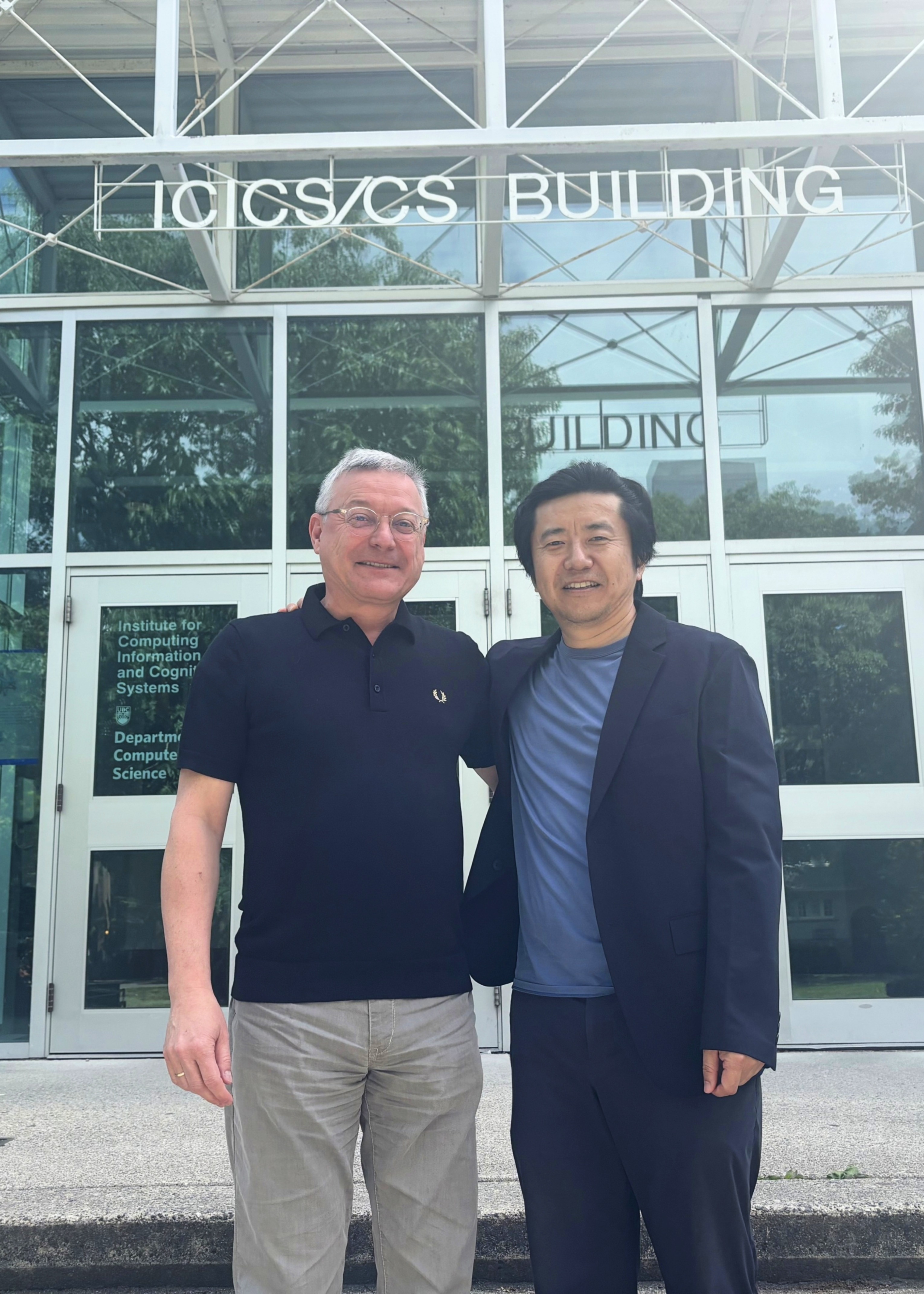
Q: Would you begin with an overview of the key developments at TP#75?
RH: We continue our tradition of holding TP meetings across the world. On this occasion, we held meetings from June 1 to 5, 2026 at the University of British Columbia. We extend many thanks to oneM2M’s hosts in Vancouver, Canada, and to Professor JaeSeung Song who coordinated logistics locally.
Our activities focused on getting ready to approve Release 5 of oneM2M’s technical specifications. Aside from new capabilities in Release 5, we have expanded the process we use to generate machine readable documents. This is an ongoing process aimed at improving developer and product manager experiences. The working procedures and format will also place oneM2M on a stronger footing for the coming AI agent era, where non-human users will interact with oneM2M technical reports and specification documents.
We also continued work on oneM2Ms Release 6. There, the current focus is mainly on Technical Reports (TR) comprising studies, use cases, and potential requirements.
While we continue to address new standardization requirements through our roadmap, we should not lose sight of deployments that use oneM2M’s horizontal architecture and basic IoT capabilities; these are among the functions that we specified in the earlier and foundational Releases of oneM2M. To this end, we had a field-report on the use of oneM2M in a large-scale system that began operations a few years ago. As I will describe later, this oneM2M-based system supports live services in Seongnam, which is the tenth largest city in South Korea.
Q: What is involved in preparing for Release 5?
RH: Our major focus was on progressing the document conversions towards Git for all Release 5 Technical Specifications (TS). This transformation process from word to Git-based spec development runs in parallel to the development and standardization of features.
This is a challenging task because technical specifications require high quality control standards. The document conversion process includes both the format conversion and a thorough review of the TSs. Sometimes, reviewers find inconsistencies that require corrections within and across TSs, mainly TS-0001 and TS-0004. These two are key documents in the specification’s family. TS-0001 defines oneM2M’s functional architecture. It focuses on the service layer aspects and takes a network-independent view of the end-to-end IoT-enabling services. TS-0004 specifies core protocols used in oneM2M’s service layer. The update process also applies to approved editorial corrections. You can see that there is much to do; we are still in in process of updating TS-0001, TS-0003 and TS-0004 with a goal of finalizing everything by the next TP which is TP#76 taking place in September.
A phase 2 of this transformation could further leverage the machine-readable specifications. For instance, there could be an automated syntax and semantics check. We might also need a set of complementing deliverables when we think about the use of LLM prompting “skills” that focus on AI-agents as a new target audience.
Q: Before we talk about the field report from S. Korea, what were the main developments in oneM2M’s Working Group sessions?
RH: Massimo Vanetti (SBS) chaired the Requirements & Domain Models (RDM) working group sessions. Addressing the theme of Bridging Metaverse and Physical Worlds via oneM2M, delegates agreed on the following three use cases and their inclusion in TR-0069.
- Metaverse Device Modelling and IoT Interworking
- City-scale Metaverse with Federated Urban IoT Data
- Location-aware IoT Device Binding in a Metaverse
During the WG sessions, there was also a discussion on the topic of Digital Twins. Two contributions were introduced, one on Digital Twin Composition and the other on Digital Twin Gaps. The scope of this work item on Digital Twins aims to capture new requirements that are needed to support Digital Twins in oneM2M. Where needed, the RDM group’s activities will involve defining appropriate mappings and/or extensions to existing specifications.
Semantic interoperability is gaining recognition in the IoT industry as we can see from some of the recent oneM2M interviews. In keeping with this theme, delegates agreed a new baseline for TS-0034-v5.0.3. This TS specifies several semantic functions for oneM2M’s functional architecture including basic resource procedures and functional descriptions.
Peter Niblett (Exacta) chaired the System Design & Security (SDS) working group. SDS is actively contributing to the Git document migration process. Members agreed on new Git-based baselines of Release 5 Technical Specifications in the following areas: TS-0008 - CoAP protocol binding, TS-0009 HTTP binding protocol, TS-0014 oneM2M LWM2M Interworking, TS-0016 Secure Environment Abstraction, TS-0035 OSGi Interworking, and TS-0040 Modbus Interworking.
The conversion process to markdown still in progress for these three specifications: TS-0001 Functional Architecture, TS-0003 Security Solutions, and TS-0004 Service Layer Core Protocol. They are currently at the review stage. Prior to formal approval.
In addition to their Git-transition responsibilities, SDS delegates also made progress on several Release 6 TRs. One is TR-0077 which outlines oneM2M and MEC integration scenarios and mechanisms arising from the ETSI STF685 project on integrating oneM2M and Multi-access Edge Computing (MEC). The second area of progress involves TR-0079 robot operating system (ROS) interworking, and TR-0081 AI Agent Interworking. Delegates also agreed on changes to TS-0001 and TS-0004.
The final of our three WGs, the Testing & Developers Ecosystem (TDE) working group was chaired by Bob Flynn (Exacta). The group held three sessions during TP75 during which they agreed to introduce several new features for the Git-based process. Among them is a new way to make easy updates and to present work item progress on the specifications.onem2m.org webpage.
TDE delegates also made progress on several developer guides including the following:
- TR-0083: Developer guide on the use of SDT & SAREF in oneM2M for Large Action Models-V0.0.1
- TR-0084: Developer guide on the use of oneM2M resources to support Federated Learning V0.1.0
- TR-0085: Developer guide on coding agents for automated IPE development V0.0.1
- TR-0086: Developer Guide for oneM2M and MEC deployment
Another TDE WG activity is to organize an IoT developer event on 2-4 September, and an international hackathon later in the year. The first of these, a oneM2M developer interoperability and conformance testing event, will be hosted by TTA from September 2-4, 2026, in South Korea. This event will provide participants with the opportunity to validate interoperability, verify implementation behaviour, and perform conformance testing in a collaborative technical environment. The scope of the interoperability testing includes the following areas:
- CSE-to-CSE registration
- Announcement
- GeoQuery
- MQTT binding
- WebSocket over MQTT
- oneM2M interworking with ETSI MEC
In addition, conformance testing activities will be conducted in parallel throughout the event.
Q: Let us now turn to the field report. What is the scope of the deployment and how does oneM2M feature in the system?
RH: We received the field report from Cheol-Min Kim at the closing TP session. His presentation was about a large-scale AIoT (Artificial Intelligence of Things) field demonstration in Seongnam, South Korea. The scope of the demonstrator covers a 1 km² area with a focus on high-reliability, continuous operation; the system operates 24-hours a day. It processes 1 million messages every 24 hours and one target KPI is 99% delivery reliability.
The network architecture combines a TTA standard LPWAN (LoRaWAN-class) for connectivity and a oneM2M-compliant Mobius4 platform. Mobius-4 is an open-source platform coming from the South Korean market. Its central role is to manage various services, including flood protection, public safety in parks, and campground management. The system connects to smart poles in urban areas. These are multifunctional poles that feature CCTV, RF gateways, microphones, and speakers. There is Edge AI functionality in the system to support on-device detection at the poles. This allows for selective monitoring to detect falls, assaults, perimeter breaches in parks, and objects in flooded areas.
Korea Electronics Technology Institute (KETI) is the lead organization for the project that has been in operation since 2022 and is due to end in June 2027. Cheol-Min Kim’s report emphasised the successful integration of low-power wide-area network (LPWAN) devices into the oneM2M framework. By using LwM2M resource models and decoding data into JSON, the system ensures that device data is readable and easily integrated into a broader Smart City Data Hub. Furthermore, the project follows a "standards-first" approach, capturing the system architecture as a three-part TTA standard series to enable future nationwide rollout of intelligent technologies.
Q: To close, what are the plans for oneM2M’s next Technical Plenary?
RH: The TP#76 meeting, covering TP and WG meetings will be hosted by the Sejong University in Seoul, South Korea, from September 7-11, 2026.
Prior to the TP meeting the oneM2M Developer Interoperability and Conformance Testing Event will be held from 2-4 September 2026 at a different venue in Seoul. TTA will be oneM2M’s host at their Global IoT Testing & Certification Center.
